
This post contains affiliate links. As an Amazon Affiliate, I earn a commission on purchases made through my links- thank you!
Before I had my second baby, I thought a lot about the big things.
How would my toddler adjust to having a sibling? Would he be jealous? How would I divide my attention? What would those first few weeks with a newborn and toddler look like?
What I didn’t think nearly as much about were the ridiculously practical questions.
Which kid do I put in the car first?
How am I supposed to grocery shop when they both need to sit in the cart?
How do I take two little kids into a public bathroom by myself?
What happens when my toddler needs help on the playground and my baby is sitting in a stroller 20 feet away?
Going from one child to two meant figuring out a whole new set of tiny systems.
None of these systems are groundbreaking. They’re simply the little things that made life with a baby and toddler easier for our family—and they’re exactly the things I wish I’d thought about before I suddenly needed to figure them out.
So, if you’re preparing for baby #2, here are some of the everyday logistics you may want to start thinking about.
Quick Takeaway: Going from one to two kids isn’t just about doubling diapers and adding another car seat. Everyday routines like getting out of the car, grocery shopping, bath time, playground trips and bedtime suddenly require a new strategy. You don’t need to have everything figured out before baby arrives, but having a few simple systems can make those early outings and routines feel much more manageable.
Preparing for another baby? This is also a great time to go through all the baby gear you’ve been storing. Read my What I Would Keep vs. Get Rid of Between Babies guide for what I was glad I saved—and what I wish I hadn’t.
1. Figure Out Your Parking Lot Order of Operations
This was one of those things I had never considered until I actually had two kids.
When we were getting into the car, I put my toddler in first and then the baby.
When we were getting out of the car, I reversed it: baby came out first, then toddler.
My reasoning was simple. I didn’t want my toddler standing loose in a parking lot while I was leaning into the car buckling or unbuckling the baby.
If my toddler was outside of the car, I wanted to be available to hold his hand.
Our system became:
Getting IN: Toddler → Baby
Getting OUT: Baby → Toddler
It was such a tiny routine, but once I had an order I followed automatically, it was one less decision I had to make every single time we went somewhere.
Your setup may be completely different depending on your children’s ages, your vehicle and your surroundings. The important part for me was simply thinking through the process before I had two little kids standing beside a car.
2. Your Grocery Shopping Strategy Will Keep Changing
Grocery shopping with two little kids has stages.
When my second was a newborn, I would babywear the baby and put my toddler in the shopping cart seat.
It worked really well for us because both kids were close to me and I still had the entire cart available for groceries.
Then the baby got older.
Once she could reliably sit in a shopping cart seat, I suddenly started noticing something I’d barely paid attention to before having two kids:
Which stores have carts that can hold TWO children?
Around me, I’ve found several great options.
Target usually has a larger cart near the front of the store. Wegmans and Home Depot (not grocery shopping of course!) have carts with steering wheels—which are obviously much more exciting when you’re a toddler. I’ve also found two-child options at stores like Aldi and Costco.
My advice from personal experience is simply to keep an eye out while you’re already shopping.
You don’t necessarily need to research every grocery cart in town. Once you start paying attention, you’ll begin noticing which stores around you make shopping with two little kids easier.
And honestly, the steering wheel carts can turn grocery shopping into an activity in itself.

3. You Start Building a Mental Map of “Two-Kid-Friendly” Places
This became an unexpected theme for me.
I started noticing things about businesses and public spaces that I’d barely thought about before.
Does this store have a double shopping cart?
Does this place have a family bathroom?
Is that playground fenced?
Is there enough room to maneuver with both kids?
You slowly build this little mental map of the places in your community that make outings with two young children easier.
So while you’re still pregnant or during those early newborn outings, start paying attention to your surroundings.
You may be surprised by how valuable that information becomes later.
Preparing for the hospital? Check out my favorite hospital gifts from baby to big sibling for adorable memories after delivery.
4. Think About How You’ll Handle Stairs
Here’s another question I hadn’t spent much time contemplating:
How exactly am I getting a toddler AND a baby upstairs?
What worked for us was having my toddler walk up the stairs holding the handrail while I walked directly behind him carrying the baby.
It sounds incredibly mundane—and it is.
But that’s really the point of this entire post.
Going from one to two kids is full of moments where something you’ve done a thousand times suddenly requires a new order of operations.
Think through the places in your home where you routinely carry your toddler now and how that routine may change once your hands are occupied with a baby.
5. Family Bathrooms Become Absolutely Amazing
Family bathrooms. Seriously.
Keep an eye out for them.
Taking a toddler into a public bathroom while also managing a baby, stroller, diaper bag and everything else you’re carrying can become its own logistical event.
Family bathrooms gave us more space to keep everyone together and manage what everyone needed.
Just like I started noticing which stores had two-child shopping carts, I started noticing which of our regular destinations had family bathrooms.
It’s another tiny piece of information that can make an outing much easier.
6. Babywearing Can Make Toddler Outings So Much Easier
Babywearing wasn’t only useful for grocery shopping.
It became one of my favorite solutions at the playground.
If my baby was sitting in a stroller and my toddler suddenly needed help across the playground, I didn’t want to have to choose between leaving the stroller or not being able to get to my toddler quickly.
So I wore the baby. My favorite baby carrier was the Ergobaby Embrace newborn carrier. I found it very easy to put on and off by myself.
The baby stayed with me, my hands were available, and I could move around with my toddler much more easily.
I also started looking specifically for fenced-in playgrounds around our community.
Again: that mental map.
Double shopping carts. Family bathrooms. Fenced playgrounds.
You’ll start noticing features you never knew you cared about.
Important: Always use baby carriers according to the manufacturer’s instructions and make sure the carrier is appropriate for your baby’s age, size and developmental stage.
7. Before You Go Outside, Bring Everything You Might Need
This became another surprisingly useful little system for us.
Before going outside to play, I tried to think ahead about what the baby might need so that I wouldn’t have to interrupt my toddler’s play to run back into the house.
Because convincing a toddler to come inside when they’re happily playing outside?
Good luck. 😂
If I thought the baby might need milk, I brought what we needed for feeding. I brought diapers and the diaper bag. I tried to have whatever I could reasonably anticipate needing with me before we settled in.
The goal wasn’t to prepare for every possible scenario. It was simply to avoid:
“Okay, everybody inside! I need to grab something for the baby!”
when my toddler had just become deeply invested in digging a hole, riding his bike or doing whatever extremely important toddler activity was happening at the moment.
This applies beyond your backyard, too. Before you settle into a playground, park, sporting event or other activity, think about what both kids are likely to need for the next little stretch of time.
If you’re looking for easy swaps you can use instead of “blaming the baby” I put together a helpful list you can download here.
A few extra minutes of preparation sometimes bought us a much longer stretch of uninterrupted play.

8. Create Mini Baby Stations Where Your Family Actually Spends Time
I also realized that baby supplies didn’t necessarily need to live in one central location.
If there was somewhere we spent a lot of time together, it helped to have a small stash of the basics nearby.
Think:
- Diapers and wipes
- Burp cloths
- An extra outfit
- Feeding supplies you regularly use
- A safe place to set down whatever essentials you need
You don’t need to recreate an entire nursery in every room.
The idea is simply to ask:
“What do I repeatedly leave this space to go get?”
If you’re constantly walking upstairs for a diaper while your toddler is playing downstairs, maybe a few diapers and wipes belong downstairs too.
If you spend every afternoon outside, maybe your diaper bag stays stocked and ready to grab.
These tiny stations reduced some of the back-and-forth and helped me stay where both kids were already happily playing.
Related: This is the same philosophy I use for encouraging a little more toddler independence. See my Toddler Independence Cabinet for another simple home system that helped reduce how often my toddler needed me to stop what I was doing to get everyday things for him.
9. Set Up Bath Time Before Anyone Touches the Water
Bath time was another routine that required some redesigning.
When my second was little, I would have my toddler in the regular bathtub and put the baby’s small tub beside the larger tub.
That allowed me to sit with them and stay close to both children while they were bathing.
But the biggest lesson?
Bring ABSOLUTELY EVERYTHING you could possibly need before you start.
Towels.
Diapers.
Pajamas.
Clean clothes.
Baby’s bottle or milk/formula if you’ll need it.
Anything you’re going to want during or immediately after bath time.
Then double-check.
Once the kids are in the water, bath time isn’t the moment to discover the baby’s diaper is in another room.
Bath Safety Note: This is simply the setup that worked in our home, not a universal bath setup or safety recommendation. Babies and young children require close, constant adult supervision around water. Follow current pediatric water-safety guidance and use bath products according to their manufacturer’s instructions.
10. Bedtime Might Take Some Trial and Error
Bedtime was one routine we changed as we figured out what worked best for our family.
For a while, we did bedtime together.
And honestly? That’s really fun.
It’s a chance to bond as a family, cuddle, read books and end the day together.
It’s also slightly more chaotic.
Eventually, we switched to more of a divide-and-conquer approach.
I would put the baby to bed while my toddler spent time with my husband. Then it was my toddler’s turn.
I ended up really loving this because it created something I hadn’t necessarily planned:
built-in one-on-one time with each child every day.
Instead of everyone competing for attention at the same time, bedtime became an opportunity for each child to have some calmer individual attention.
But I don’t think there is one magical two-kid bedtime routine.
Your kids’ personalities, ages, sleep schedules and your family’s schedule all matter.
This is one of those routines where you may have to experiment.
Together can be sweet and fun.
Separate can be calm and give everyone individual attention.
Try things. Change things. Keep what works.
11. Try Not to Make the Baby the Reason You Can’t Do Something
This was something I became really intentional about with my language.
When my toddler wanted me and I was caring for the baby, I tried not to say:
“I can’t. I’m feeding the baby.”
Instead, I might say:
“My hands are busy right now. When they’re free, I’ll play XYZ with you.”
It’s a subtle difference, but it mattered to me.
I didn’t want the baby to constantly become the reason Mom couldn’t do something.
Sometimes my hands were simply busy.
When they were free, I could give him my attention again.
If you want a helpful free guide of what to say instead of blaming the baby, I put together a helpful list. You can download the “Don’t Blame the Baby” Swaps here.
Getting a new sibling can bring up a lot of big feelings. Check out my list of items I find helpful when teaching my toddler about big feelings.
12. Let the Baby “Wait” Sometimes, Too
Along the same lines, I didn’t want my toddler to be the only child who constantly heard, “You need to wait.”
So I would sometimes say out loud:
“Baby, you’ll have to be patient for a minute. I’m helping your brother.”
Obviously, my newborn wasn’t sitting there analyzing whether I was distributing my attention equitably and I did this at times where she was already content.
My toddler was listening.
I wanted him to hear that sometimes I helped the baby first, and sometimes I finished helping him first.
His needs still mattered.
This wasn’t about making everything perfectly equal. That’s probably impossible.
It was one little way I tried to make our new family dynamic feel less like the baby always comes first.
You can download a helpful list of alternatives to blaming the baby in common situations. I put the “Don’t Blame the Baby” guide to be helpful in situations just like this — where you don’t quite have the words (or the hands) in the moment.
13. Find Little Ways to Make Your Older Child Part of Baby Care
When the baby needed something while I was spending time with my toddler, another thing that helped was getting him involved when it made sense.
Instead of baby care always interrupting what we were doing, I could sometimes make him part of it.
Toddlers love being important.
Even a tiny job or getting excited about helping can change the feeling of the interaction.
Of course, your toddler doesn’t need to become your tiny newborn assistant. Sometimes they just want Mom or Dad.
But I liked finding little opportunities to reinforce the idea that this was our baby and our family, rather than this new person who had suddenly arrived and taken everyone’s attention.
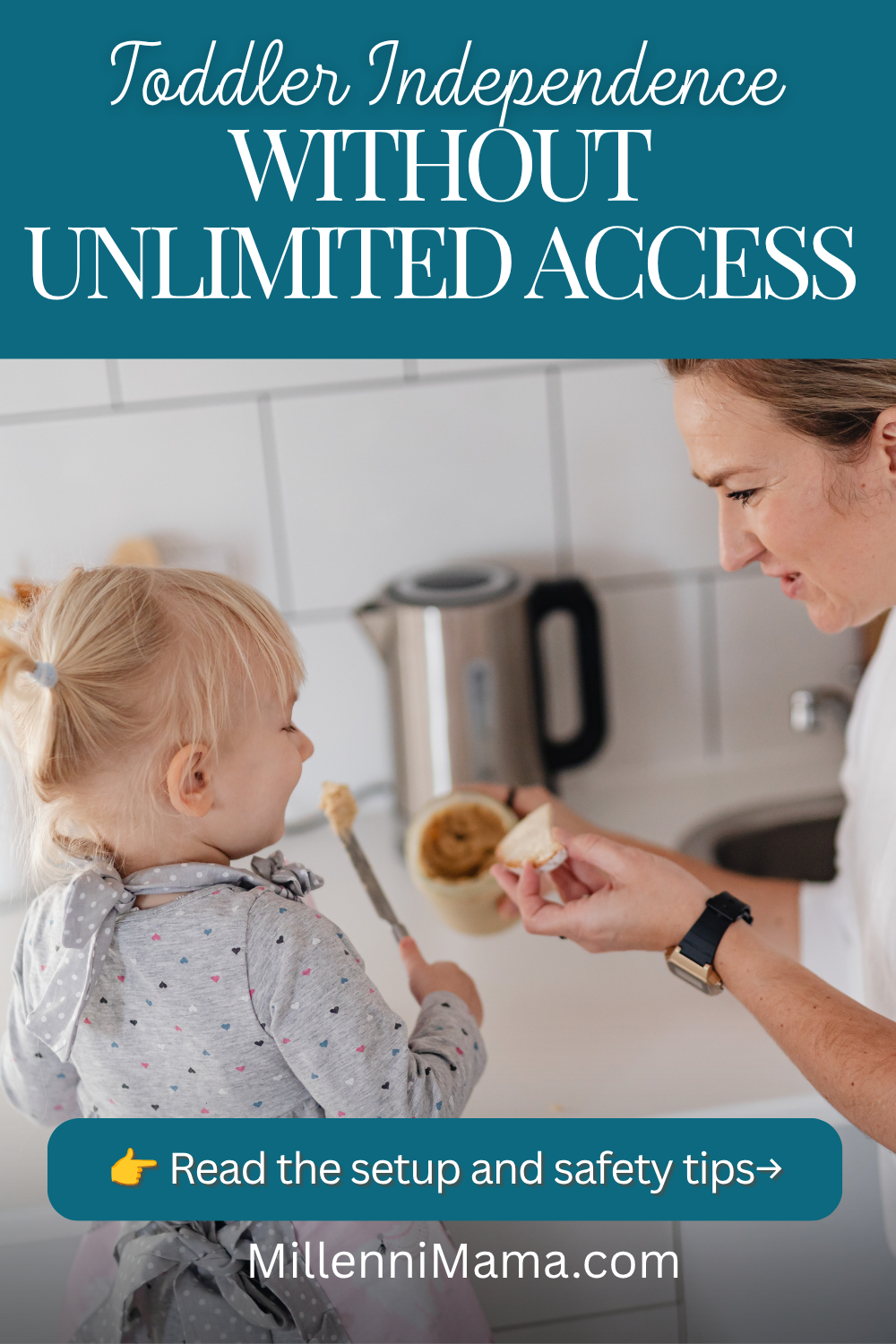
Want another way to give your toddler some age-appropriate ownership over their day? My Toddler Independence Cabinet shows how we set up a simple space where my toddler could access some everyday things himself.
14. You Don’t Need to Perfect Every Routine Before Baby Arrives
If you’re pregnant with baby #2 and reading all of this thinking:
Great. Apparently I also need a grocery-shopping strategy and a public-bathroom strategy.
You don’t.
You will figure these things out.
Some of our systems worked immediately. Others changed as the baby got older.
The grocery-shopping strategy changed once the baby could sit in the cart.
Bedtime changed.
Outings changed.
What worked with a newborn wasn’t necessarily what worked with a mobile baby.
That’s something I wish I’d understood better beforehand:
You aren’t creating one permanent system for having two kids.
You’re creating little systems for the stage you’re in right now.
When they stop working, you adjust.
15. And Please Remember to Take the Pictures
We took approximately one million photos of my son when he was a baby.
When I had my second, I really wanted to make sure I documented her babyhood too.
But I realized there was something even more special to photograph this time:
the two of them growing together.
I added sibling pictures to the regular monthly milestone photos I was already taking.
That gave me a reminder not only to document how much the baby had grown, but also to capture their relationship changing.
And take pictures of the tiny details.
Their hands together.
Their feet next to each other.
Big sibling holding baby’s hand.
The enormous size difference that somehow won’t look enormous for very long.
Seriously. The hands and feet together are SO adorable.
With your first baby, you’re documenting someone becoming a person right in front of you.
With your second, you get something else too.
You get to watch two little people become siblings.
Going From 1 to 2 Kids Doesn’t Mean Having Everything Figured Out
Going from one child to two definitely added more logistics to our lives.
But I don’t think the answer was becoming twice as organized.
It was creating a handful of tiny systems that removed decisions from everyday moments.
Toddler into the car first.
Baby out first.
Babywear at the playground.
Bring the diaper bag outside before everyone gets settled.
Keep the things you constantly need close to where you actually spend your time.
Notice the double carts.
Find the family bathrooms.
Put everything beside the bathtub before bath time begins.
Experiment with bedtime.
Be thoughtful about the words I used when both kids needed me.
None of these things is revolutionary.
But together, they made our days feel more manageable.
And somewhere between figuring out shopping carts, parking lots, baths and bedtimes, something much bigger was happening.
We weren’t just learning how to manage life with two kids.
We were learning how to be a family of four.
And watching our children become siblings has been one of the sweetest parts of it.
Your Next Read
If you’re preparing for another baby—or you’re already in the baby-and-toddler stage—these MillenniMama resources can help with some of the other little decisions that come with this season:
What I Would Keep (and Get Rid of) Between Babies
Not everything from baby #1 is worth storing. I’m sharing what held up well enough to use again, what I regretted keeping and what I would absolutely save for another baby.
→ Read: What I Would Keep vs. Get Rid of Between Babies
My Toddler Independence Cabinet
One of my favorite simple systems for giving my toddler more independence with everyday tasks—and reducing some of the constant “Mom, can you get me…” mental load.
→ See Our Toddler Independence Cabinet
Choosing a Breast Pump That Actually Fits Your Lifestyle
Wall pump, portable pump or wearable? I’ve used different styles of pumps, and the right setup can depend heavily on how and where you need to pump—especially when you’re also caring for an older child.
→ Read: Wearable vs. Portable vs. Wall Breast Pumps
Glass Baby Bottles: What I Used and What I Learned
I used glass bottles extensively with my second baby, including Philips Avent Natural Response bottles. Here’s what I liked, what happened when we dropped them and the backup bottles I kept around.
→ Read My Glass Baby Bottle Guide
Baby Gear Worth Keeping Between Kids
If you’re deciding what deserves precious storage space before another baby, my reviews of the baby gear we’ve actually used can help you decide what may make sense for your family.
→ Explore MillenniMama Baby Gear & Real Mom Reviews
FAQ: Going From One Child to Two
Is going from one to two kids hard?
It can require a lot of adjustment because routines that worked with one child may suddenly need to accommodate two different ages, schedules and needs. In my experience, figuring out a few small systems made the everyday logistics feel much more manageable.
How do you grocery shop with a newborn and toddler?
When my second was a newborn, I babywore her while my toddler rode in the shopping cart seat. My favorite baby carrier was the Ergobaby Embrace newborn carrier. I found it very easy to put on and off by myself.
Once the baby could reliably sit in the cart, I started looking for stores around me that offered carts designed to accommodate two children.
How do you manage outings alone with a baby and toddler?
For me, preparation and babywearing helped a lot. Before settling somewhere, I tried to bring what the baby was likely to need so I didn’t have to immediately interrupt my toddler’s play. I also learned which places around us had helpful features like fenced playgrounds, family bathrooms and two-child shopping carts.
How do you handle bedtime with two young children?
We tried both doing bedtime together and splitting bedtime between parents. Doing it together gave us family bonding time, while separate bedtimes gave each child calm one-on-one time. This was one routine where trial and error helped us find what worked for our family’s current stage.
How can I help my toddler adjust when the baby needs a lot of attention?
One thing I personally tried was avoiding language that made the baby the reason I couldn’t give my toddler attention. Instead of saying, “I can’t because I’m feeding the baby,” I might say, “My hands are busy. When they’re free, I’ll play with you.” I would also sometimes tell the baby out loud that they needed to wait while I finished helping my toddler. Download my free “Don’t Blame the Baby” Alternative guide here for moments when you have a hard time finding the right words to say.
This post shares my personal experience and is for general informational purposes only. Every child, family, home and situation is different. Always use your judgment and follow appropriate product instructions and professional safety guidance for your family.
Leave a Reply